
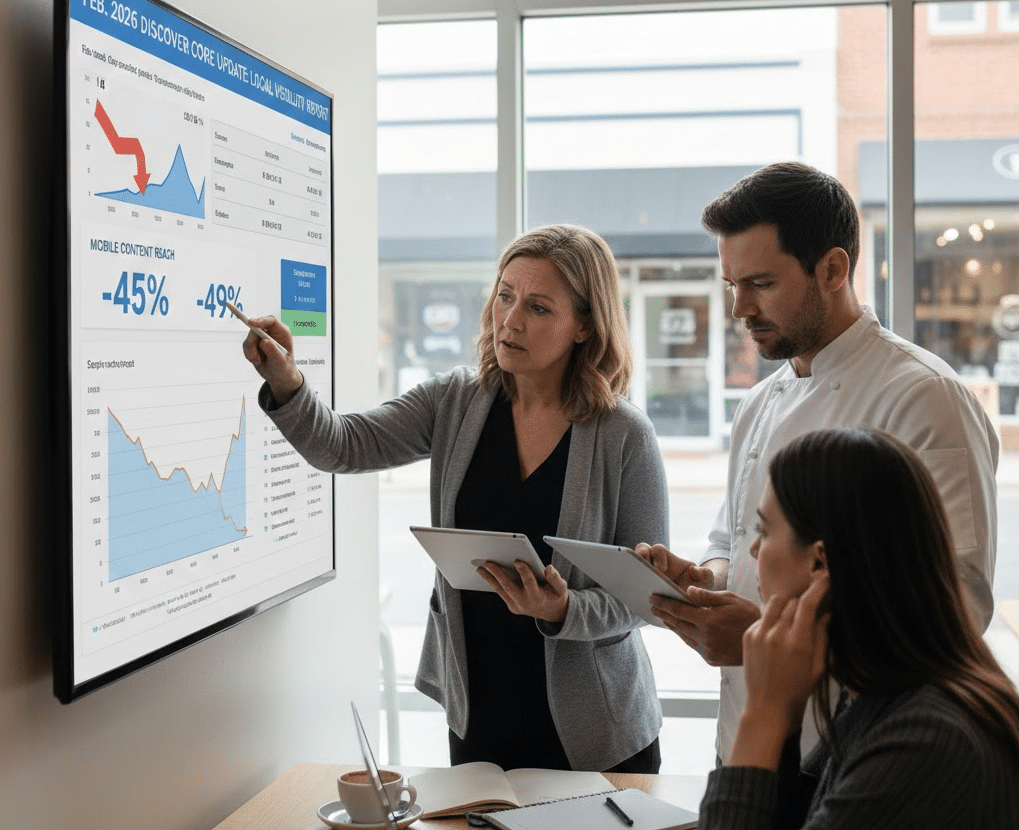
If your business has ever seen attention rise or fall without a matching change in rankings, Google Discover was likely part of the equation.
On February 5, 2026, Google announced the February 2026 Discover Core Update, a broad update focused entirely on Google Discover rather than traditional web search. At the same time, quieter but important shifts in AEO and GEO are reshaping how businesses appear inside AI answers, summaries, and conversational results.
Taken together, these changes show where visibility is moving in 2026. Earlier. More local. More trust driven. Less dependent on clicks alone.
This article breaks down what changed, why it matters for local markets like Harlingen and surrounding areas, and how businesses can adapt without chasing every headline.
The February 2026 Discover Core Update, What Actually Shifted?

This update applies specifically to Google Discover, the personalized feed shown on mobile devices and the Google homepage.
Google confirmed three primary changes. Discover now prioritizes content from websites based in the user’s country. Sensational or click driven articles are being reduced. In-depth, original, and timely content from sites with demonstrated expertise is being surfaced more often.
In practice, this favors real local businesses over generic publishers.
A locally owned coffee shop in Harlingen publishing an update about seasonal drinks sourced from regional roasters is now better positioned than a national food site recycling broad coffee trend lists. Discover is learning to reward proximity, relevance, and authenticity together.
The rollout began with English language users in the United States and is expected to expand globally over the coming weeks. Discover traffic movement during this window is normal and should be evaluated over weeks, not days.
What You Can Do: Establish a Discover baseline now. Pull weekly Discover impressions and clicks from Search Console and note which posts include clear local context or timing. Patterns often emerge after two to three weeks. Avoid major content removals or site changes mid rollout. Let the data settle before reacting.
Can Your Location Become a Visibility Advantage Again?
One of the most encouraging signals from the February 2026 Discover Core Update is the renewed importance of place.
Content grounded in real communities, timing, and regional needs now aligns better with Discover’s evaluation systems. Businesses that reflect local realities naturally are no longer competing as directly with national content farms.
A fitness studio serving Harlingen might publish guidance on adjusting workouts during prolonged South Texas heat. A home services provider might share insights on preparing properties for early spring conditions common to the region. These posts carry signals that generic “2026 trends” articles do not. Discover is reconnecting visibility to lived context.
Why location now matters more
- Discover prioritizes country and region relevance
- Local timing and environment provide natural context
- Community specific insight outperforms generic advice
- Real world conditions signal authenticity
Examples of location driven content
- Fitness guidance adapted for regional climate
- Seasonal maintenance tips tied to local weather patterns
- Service advice based on common regional issues
- Updates aligned with community routines
Actionable Tip
- Review recent content and ask if it would feel incomplete if the location changed
- If it could apply anywhere, add context through environment, seasonality, or customer behavior
- Reference local timing, climate, or routines naturally
- Focus on grounding, not repeating city names
Why Is Discover Rewarding Clarity Over Click Pressure?

Google Discover is actively reducing the reach of exaggerated headlines and low substance articles.
This shift benefits businesses that already communicate plainly with customers. Clear titles and honest explanations now outperform curiosity driven hooks.
A Harlingen based home services provider explaining “What to Expect From Spring Maintenance This Year” aligns better than dramatic headlines promising unexpected disasters. The former builds trust. The latter creates friction.
This mirrors how customers actually choose local businesses.
Optimization Insight: Audit your headlines using a trust test. Would you say this exact sentence to a customer in person? If not, simplify it. Replace vague promises with clear outcomes. Discover engagement improves when readers understand value immediately and feel respected rather than persuaded.
How Does Real Expertise Influence Discover Visibility?
The February 2026 Discover Core Update places more weight on depth, originality, and real experience.
Local businesses are uniquely positioned here. A bakery explaining ingredient sourcing challenges, a salon discussing humidity related hair care, or a trades business outlining seasonal issues they see repeatedly all demonstrate firsthand knowledge.
These insights are difficult for large content publishers to replicate at scale.
Practical Move
List the five questions customers ask your team most often. Turn each into a short post tied to current conditions or seasons. Use real examples or photos when possible. Specific experience builds trust faster than polished marketing language.
Is Discover Reaching Customers Before They Search?
Yes, and this is where Discover quietly shapes outcomes.
Discover introduces brands before active intent forms. Users encounter content while browsing casually, not searching. This early exposure influences which businesses feel familiar later.
Someone scrolling Discover might see a post from a local restaurant about an upcoming seasonal menu weeks before deciding where to eat. When the moment arrives, recognition already exists.
The February 2026 Discover Core Update strengthens this early awareness role.
Strategic Takeaway: Treat Discover content as awareness infrastructure. Publish posts meant for browsing, not immediate conversion. Seasonal updates, behind the scenes stories, and community focused insights fit Discover behavior best. Track branded searches and profile actions alongside Discover impressions to see how early exposure leads to action.
Where AEO and GEO Fit Into the February 2026 Conversation
While the Discover update drew attention, the past week also brought meaningful developments in AEO and GEO. These changes reflect industry maturation rather than new platform level algorithms.
AEO focuses on answer durability, how consistently your business appears across AI responses and follow up questions. GEO focuses on presence, whether your business is mentioned or cited inside AI generated answers.
US enterprise data shows AEO and GEO are now top marketing priorities for 2026, with budgets shifting accordingly.
For local businesses, this matters because AI answers increasingly replace clicks.
Execution Tip: Structure content so answers are easy to extract. Use clear headings, concise explanations, and short summaries. Avoid burying key information deep in paragraphs. Durable answers tend to appear more consistently across AI systems.
How Model Changes Are Quietly Affecting Visibility

OpenAI’s accelerated model deprecations are forcing tools and agencies to migrate quickly. Thousands of AI driven products relied on older models, creating short term volatility in citation reliability.
This transition favors businesses with consistent, verifiable information.
Local businesses with accurate NAP details, clear service descriptions, and original content often retain AI citations better during these shifts.
Checklist Item: Verify consistency across your website, Google Business Profile, and key directories. Ensure service descriptions match across platforms. Clean entity data helps maintain visibility when AI models and tools change underneath.
How Discover, AEO, GEO, and Google Business Profile Reinforce Each Other
The February 2026 Discover Core Update does not operate in isolation.
Discover introduces awareness. AI answers reinforce credibility. Google Business Profile confirms legitimacy. Each surface supports the others.
In areas like Harlingen and surrounding communities, businesses that align content publishing with profile activity often see stronger outcomes.
Coordination Tip: When you publish a locally relevant post, update your Google Business Profile with fresh photos or a short post around the same time. This reinforces freshness signals across surfaces and increases the chance that early exposure leads to calls or visits.
What This Means for Local Businesses in 2026
Early 2026 data shows visibility is being redistributed rather than removed. Some businesses see fewer website visits but stronger calls or direction requests. Others notice Discover impressions rising while traditional blog traffic softens. These are signs of shifting decision points, not decline.
Websites still matter, but their role has evolved. They now support trust and confirmation rather than acting as the primary entry point.
For businesses serving Harlingen and nearby communities, alignment across Discover content, AEO readiness, GEO presence, and local activity is producing stronger results than focusing on any single channel alone.
Let’s Talk Local
Consider a service business operating in Harlingen.
Website sessions fluctuate slightly year over year. Discover impressions increase when the business publishes regionally relevant updates tied to seasonal demand. Google Business Profile data shows increased calls and direction requests even when traffic softens.
Customers encounter the brand through Discover, confirm details through AI answers or local listings, and then act. Decisions form earlier, with fewer steps. Visibility, essentially, has shifted upstream.
What is the February 2026 Discover Core Update?
The February 2026 Discover Core Update is a Google update focused specifically on Google Discover, not traditional web search rankings. It changes how content appears in the Discover feed on mobile devices and the Google homepage. The update prioritizes locally relevant, original, and in-depth content while reducing sensational or low-quality articles. Its goal is to surface content users trust and find useful earlier in their decision process.
Does the February 2026 Discover Core Update affect Google Search rankings?
No. This update does not directly change traditional Google Search rankings, map pack placement, or keyword positions. It only affects Google Discover visibility. However, Discover exposure can indirectly influence branded searches, profile engagement, and customer familiarity, which may support overall performance over time even if rankings remain unchanged.
Why did my Discover traffic change even though my site looks the same?
Discover traffic often shifts during core updates because Google is recalibrating what it surfaces, not because something is broken. Content that lacks local context, depth, or originality may appear less often, while posts tied to real experience or timely topics may gain visibility. These changes usually stabilize after the rollout completes, which can take a few weeks.
What type of content performs best in Google Discover now?
Content that performs well in Discover is timely, locally grounded, and experience based. Examples include seasonal updates, behind-the-scenes insights, community involvement, service explanations, or real-world guidance. Clear headlines, real photos, and practical value matter more than length or frequency. Discover favors usefulness over promotion.
How do AEO and GEO relate to Discover?
Discover, AEO, and GEO all support early visibility. Discover introduces awareness. GEO focuses on being mentioned or cited in AI generated answers. AEO focuses on how consistently a business appears across AI conversations. Together, they reduce reliance on clicks and emphasize trust, clarity, and entity consistency across search, AI answers, and local surfaces.
Do local businesses need AEO and GEO in 2026?
Yes. AI answers now appear in a large share of searches, often replacing clicks. For local businesses, being cited or mentioned in AI responses builds credibility and visibility even when users never visit a website. Strong local signals, clear service explanations, and consistent business information improve both AEO durability and GEO presence.
Is Google Business Profile still important with Discover and AI answers?
Yes. Google Business Profile remains foundational. Discover may introduce a brand, but profiles often confirm legitimacy before action. Reviews, photos, services, and updates influence decisions even when website traffic declines. In 2026, profiles function as conversion layers that support Discover exposure and AI answer credibility.
What should local businesses focus on first after this update?
Start with clarity and consistency. Audit content for local relevance, real expertise, and usefulness. Ensure business information matches across the website and profiles. Publish timely updates tied to real customer needs. Monitor Discover and branded search trends weekly rather than reacting day to day. Sustainable visibility now comes from alignment, not volume.
Acting on Discover, AEO, and GEO Without Guesswork
The February 2026 Discover Core Update, paired with accelerating AEO and GEO adoption, points to a clear direction. Visibility now favors relevance, depth, and trust over volume and tactics.
At Scale by SEO, our services include helping local businesses interpret Discover movement, monitor AI answer presence, and align content with how visibility works in 2026.
If your business serves Harlingen or surrounding communities in the Rio Grande Valley and visibility patterns have changed, a free site audit from Scale by SEO can help clarify what is happening, where opportunities exist, and what actions make sense next.