
Google AI Search Update May 2026: What Changed and How to Win
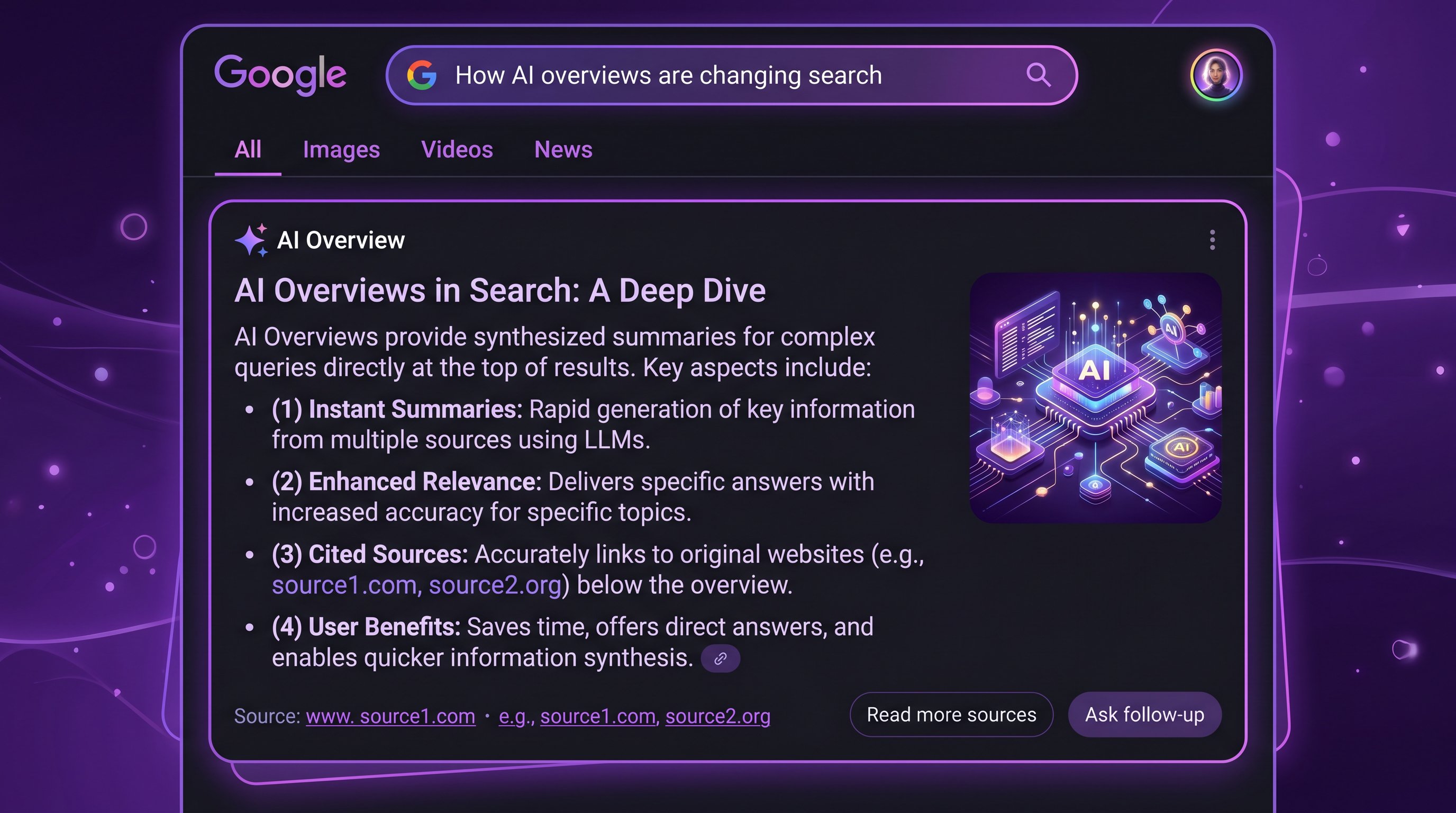
When was the last time you clicked past the first thing Google showed you? If you're like most people in 2026, it's been a while, and the Google AI search update May 2026 is the reason. Google's search page now thinks, summarizes, and recommends before you even reach the results.
Below, we'll break down what changed under the hood, why it's the biggest shake-up to search in 25 years, and what it means for students writing essays, shoppers comparing prices, and small business owners trying to get found. Friendly explanations, zero fluff, real tips you can use this week.
What Google's May 2026 AI Search Update Actually Is
Think of Google Search as a giant library. For 25 years, the librarian handed visitors a stack of books (links) and let them figure out the rest.
The Google AI search update May 2026 turns that librarian into a helpful friend who reads the books first and gives a quick summary. Announced at Google I/O on May 19, 2026, the new "intelligent search box" now accepts text, images, files, even open browser tabs.
It's powered by Gemini 3.5 Flash and feeds into two big features: AI Overviews (2.5 billion monthly users) and AI Mode (1 billion monthly users in just 12 months). On top of that, a fresh May Core Update started rolling out May 21, meaning rankings are still shifting as people read this.
For a deeper primer on how search is evolving, the team at Scale by SEO has a helpful breakdown in the SEO strategy guide.
The Biggest Changes You'll Notice in Your Search Results
If someone hasn't searched on Google in a couple of weeks, they're in for a surprise. The page looks different, behaves differently, and even talks back in a way it never has before.
Here are the two changes most people will spot right away.
Smarter AI Overviews at the Top of the Page
AI Overviews are the boxed summaries that now sit above the traditional blue links. Picture them like the "executive summary" at the top of a report, quick, scannable, and surprisingly accurate.
Google's own data shows brands cited inside these overviews earn 35% more organic clicks than competitors who aren't mentioned. So being quoted by the AI is becoming as valuable as ranking #1 used to be.
Small business owners curious about getting cited can start with content that shares first-hand expertise, something Scale by SEO's content marketing strategy post walks through step by step.
Conversational Follow-Up Questions Built Right In
The second big shift: search now feels like a chat. A user can ask "best running shoes for flat feet," then follow up with "under $100?" without retyping the whole question.
This is AI Mode in action, and Google says these conversational queries have doubled every quarter since launch. For curious learners, it's basically having a research assistant on tap.
What It Means for Marketers and Small Business Owners

Here's the honest truth for small business owners: the Google AI search update May 2026 isn't an optional assignment. It's a new playing field, and early movers will win.
The week of May 19–21, 2026 changed search forever. Google I/O, Google Marketing Live, and the May Core Update all dropped within 72 hours of each other — the most consequential search week in a decade. AI Mode hit 1 billion monthly active users in just 12 months, AI Overviews reached 2.5 billion MAU globally, and Google rolled out the biggest search box redesign in 25 years (now powered by Gemini 3.5 Flash and accepting text, images, files, videos, and open Chrome tabs simultaneously).
Google itself published its first official AI optimization guide on May 15, and the headline takeaway was blunt: "Optimizing for generative AI search is still SEO." No magic tricks needed — just solid fundamentals done well. Google's own documentation defines both AEO and GEO, then immediately folds them back under standard SEO.
Four popular tactics were officially declared useless for Google AI:
llms.txtfiles — Google confirmed they receive no special treatmentContent "chunking" — not required; Google understands full-length pages
AI-specific schema types — structured data isn't needed for AI visibility
Inauthentic mention-building — already blocked by Google's spam systems
What does work: first-hand experience content (the #1 visibility lever), original research and proprietary data, multimodal assets (images and video are now surfaced in AI answers), and clean technical hygiene. Content with stats and citations sees a 30–40% visibility lift, and AEO citations convert at 2–3× the rate of standard organic clicks.
And for anyone worried AI is killing search: Google Search ad revenue hit $60.4 billion in Q1 2026 — up 19% year-over-year. AI search is growing the pie, not shrinking it.
For local businesses, there's even better news. Google confirmed that Google Business Profile and Merchant Center activity directly influence AI answers. Every photo uploaded, review responded to, and product description polished now serves double duty.
Demand Gen ads are also rolling out to Google Maps soon — a first for visual ads on that surface. Owners of physical shops should explore the local SEO services at Scale by SEO to grab a head start, or browse practical reads like the ecommerce SEO tips for online sellers.
⚠️ One critical timing note: the May Core Update started rolling out on May 21 and takes up to two weeks. Don't make major SEO changes — content overhauls, URL restructuring, internal linking — while it's still active. Wait for Google to confirm completion before judging any traffic shifts.
Simple Tips to Get Better Answers From the New AI Search

Getting more from the new AI search is a bit like learning to order at a great restaurant, the clearer the request, the better the meal.
Here are five quick wins anyone can try today:
Ask full questions, not keywords. Instead of "coffee shops Dallas," try "quiet coffee shops in Dallas with strong Wi-Fi for remote work."
Use the follow-up feature. Refine answers in plain English instead of starting a new search.
Test logged-in vs. logged-out. Personal Intelligence changes results, so check both views before drawing conclusions.
Look beyond the AI box. The cited sources below the summary often hold richer detail.
For business owners, publish original insights. Case studies, surveys, and proprietary data are what AI loves to quote.
Which tip will readers try first, the follow-up questions or publishing original research? For more ideas, the Scale by SEO blog and the content distribution marketing guide are great next stops. Building backlinks is still huge too,
To conclude, the Google AI search update May 2026 rewards businesses that show up with genuine expertise and a tidy local presence.
Ready to turn these changes into more local customers? Visit Scale by SEO's services and let the experts handle the heavy lifting.
What exactly is the Google AI search update May 2026?
Announced at Google I/O on May 19, 2026, the Google AI search update transforms search from a link-listing system into an intelligent assistant. Powered by Gemini 3.5 Flash, it features AI Overviews (summaries above links) and AI Mode (conversational follow-ups), reaching 2.5 billion and 1 billion users respectively. It's the biggest search overhaul in 25 years.
How do AI Overviews affect click-through rates and visibility for businesses?
Brands cited in AI Overviews earn 35% more organic clicks than competitors not mentioned. Being quoted by the AI is now as valuable as ranking #1 traditionally was. Focus on first-hand expertise content to increase citation chances and improve your organic click performance significantly.
What content strategies actually work for Google's new AI search?
Google's official AI optimization guide confirms that solid SEO fundamentals still work best: first-hand experience content, original data, and clean technical hygiene. Avoid gimmicks like llms.txt files or AI-specific schema. For local businesses, optimize your Google Business Profile and product descriptions to influence AI answers.
Can I use AI Overviews to improve my small business's online presence?
Yes. Publish original insights through case studies, surveys, and proprietary data—AI loves quoting these. Update your Google Business Profile regularly, respond to reviews, and polish product descriptions. For local SEO optimization, explore Scale by SEO's local services to ensure your business gets cited in AI-generated summaries.
How does Personal Intelligence change search results after this update?
Google's Personal Intelligence feature, live in nearly 200 countries, personalizes AI answers using Gmail, Photos, and search history. Two users asking the same question may see different results. Students and researchers should verify sources, as AI isn't always neutral despite being intelligent and helpful.
What's the difference between AI Overviews and AI Mode in Google Search?
AI Overviews are the boxed summaries above traditional blue links—like an executive summary. AI Mode enables conversational follow-ups, letting users refine searches in plain English without retyping. Conversational queries have doubled quarterly since launch, creating new opportunities for businesses to engage with search users directly.